

Keep the online gallery up for 30 to 90 days, the raw files for about a year, the edited finals for six years, and your contracts and invoices for as long as your tax authority requires. Those are four different clocks, and treating them as one is what makes photographers either lose files clients ask for or pay to store terabytes nobody will ever open. In the worked example below, a photographer who keeps everything forever pays $135 a month for storage by year six. The same photographer on a four-clock policy pays $32.
Key takeaways
- No law tells you how long to keep the photos themselves. What sets the length is the period in which a client can still bring a claim, your tax record rules, and what you promise in your contract.
- Raw files are about 90% of your storage and almost never requested after delivery. They should have the shortest clock.
- Finals are small and valuable. One wedding's finals cost about $0.75 a year to keep in cloud storage.
- Photos of identifiable people are personal data in the UK and EU, so "forever" is not a neutral default. You need a reason for every year you keep them.
We build Ultra, a client gallery and booking platform, so we have an interest in how you store and deliver photos. Prices below are as of October 7, 2026, with links to each source. This is general information, not legal or tax advice; check the rules where you and your clients live.
What are the four clocks?
| What you keep | Suggested clock | What sets it |
|---|---|---|
| Online client gallery | 30 to 90 days after delivery | Your contract and your storage plan |
| Raw files and outtakes | About 12 months after delivery | Reshoot and re-edit requests, data minimisation |
| Edited finals | 6 years (UK example) | The period in which a client can sue you |
| Contract, invoices, payment records | At least 5 to 6 years | Tax and accounting law |

The table uses UK numbers because they are the clearest. The US section below covers the main differences.
How long should the online gallery stay up?
Long enough for the client to download everything and share it with family, which in practice is 30 to 90 days. A gallery is a delivery channel, not an archive. Clients who know the link expires download in the first week; clients who think it lasts forever come back in three years asking why it is gone.
Put the date in two places: in the contract ("your gallery is available for 60 days from delivery") and in the delivery email. Then send one reminder a week before it closes. That one email prevents most of the "I lost my photos" requests later.
How long should you keep raw files?
About a year after delivery, unless your contract promises something else. Raw files exist so you can re-edit, and almost every re-edit request arrives within weeks: the couple wants a different crop, an aunt wants a photo from the outtakes. After a full season, those requests stop.
The cost argument is strong. In the worked example below, raws take 2,970 GB a year and finals take 270 GB. Raws are 92% of the bill.
There is also a privacy argument in the UK and EU. Article 5(1)(e) of the GDPR requires personal data to be kept "for no longer than is necessary" for its purpose. Hundreds of unselected frames of guests have no purpose once the client has their finals. The UK regulator, the ICO, says the law "does not set specific time limits" but expects you to set and document your own (ICO storage limitation guidance). A written "raws deleted 12 months after delivery" rule is exactly that.
How long should you keep the finals?
Until a client can no longer bring a claim against you, and then a little longer if they are still worth something to you. In England and Wales, a contract claim cannot be brought more than six years after it arose (Limitation Act 1980, section 5). If a couple says years later that you never delivered the album images, the finals and your delivery records are your evidence. The ICO guidance explicitly lets you consider whether you need to keep information "to defend possible future legal claims".
The finals also make money. An anniversary print, a lost hard drive: clients come back, and having the files means you can charge for a re-delivery instead of apologising. At $0.75 per wedding per year, six years of finals for one wedding cost about $4.50.
How long do you keep contracts and invoices?
As long as your tax authority can examine them. In the UK, self-employed people must keep records "for at least 5 years after the 31 January submission deadline" of the relevant tax year (GOV.UK). Keep the signed contract with the invoices, because it is also what proves the gallery and raw deadlines you agreed.
What changes in the US?
Two things. Contract claims are governed by state law, and the time limits differ by state, so check yours. For tax, the IRS general rule is to keep records for 3 years, with longer periods in specific cases such as 4 years for employment tax records (IRS). There is no federal law equivalent to the GDPR storage rule, but a written policy still protects you: it turns "you deleted my photos" into "as agreed in section 7".
What does keeping everything actually cost?
Here is a model with numbers you should replace with your own. A photographer shoots 25 weddings and 60 portrait sessions a year. Each wedding is 3,000 raws at 30 MB and 600 finals at 15 MB. Each portrait session is 400 raws and 50 finals at the same sizes. That is 2,970 GB of raws and 270 GB of finals a year.
At Backblaze B2's $6.95 per TB per month, as an example of plain cloud storage:
| Year | Keep everything | Four-clock policy (raws 1 year, finals 6 years) |
|---|---|---|
| 1 | 3.24 TB, $22.52/month | 3.24 TB, $22.52/month |
| 3 | 9.72 TB, $67.55/month | 3.78 TB, $26.27/month |
| 6 | 19.44 TB, $135.11/month | 4.59 TB, $31.90/month |
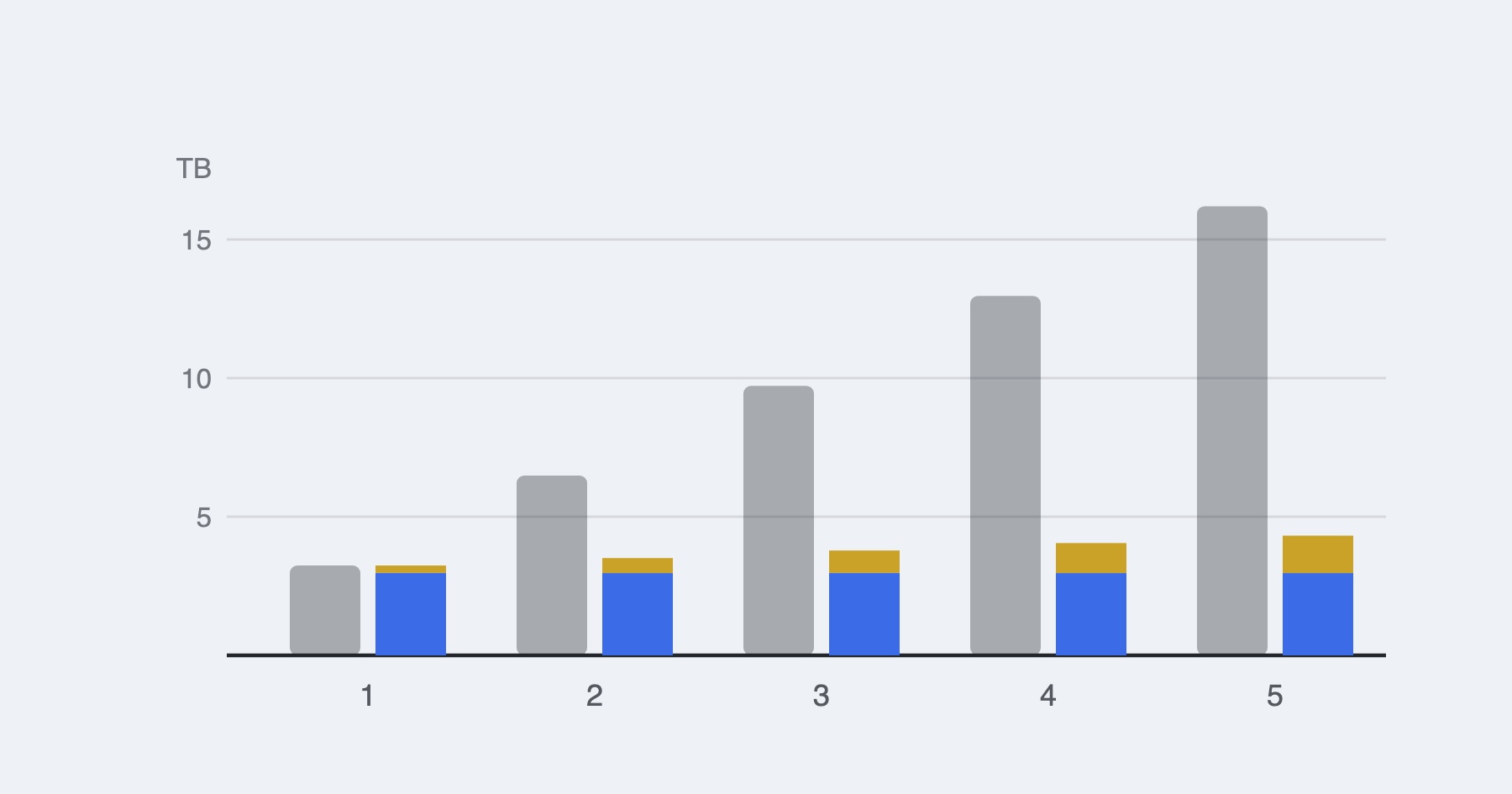
The policy line flattens because the raws roll off as fast as they come in, and only the small finals pile up. That is also one cloud copy. Keep a second copy of the finals somewhere else (a drive at home or a second provider), because a single copy is not a backup.
What should the contract say?
Three sentences cover it. Adjust the numbers to your policy:
The online gallery is available for 60 days from delivery. Please download your photos within that time. We keep the edited photos for 6 years and the unedited files for 12 months after delivery; after that they are permanently deleted.
Then add a line on re-delivery after the gallery closes, such as a fixed fee, so a request three years later is a small paid job rather than a favour.
Where Ultra fits (disclosure included)
Ultra's client galleries have a per-folder auto-delete date. You set the date when you deliver, and you choose whether the photos are removed from storage too or kept in your library. That second switch is what lets you close the client gallery after 60 days while keeping the finals for your six-year archive. Clients download single photos or the whole folder as a zip.

The Pro plan includes 1000 GB for $84 a year. In the model above, finals grow by 270 GB a year, so 1000 GB holds about three and a half years of them, and not even half a year of raws. Most photographers will still want separate cold storage for raws and older finals. Ultra is a delivery and client tool first, not a replacement for a backup. For the payment side of client work, see the real math of photography payment fees.
This week's job takes an hour: write your four clocks into the contract template, set an expiry date on every gallery you deliver from now on, and delete last year's raws from projects older than twelve months.