

You can run a legitimate photography business in your first year for about $1,160 on top of the camera you already own. That covers a contract, insurance, editing software, backups, a domain, and a place for clients to book and get their photos. At $250 a portrait session, it is paid back by your fifth client. It is easy to spend several times that, and almost all of the extra goes on things that do not book a single session: new lenses, a logo, paid ads and courses.
Key takeaways
- The essentials list is short: a contract, a deposit, insurance, backups, a booking page and a delivery gallery. Everything else can wait for paying clients.
- Your year-one budget is a number you can hit with a handful of sessions. Work it out before you buy anything.
- Pick one kind of photography for your first year. A portfolio of one thing books that thing.
- The order matters: contract and pricing before your first paid shoot, backups before your first wedding.
We build Ultra, a booking and gallery platform for photographers, so one line in the list below is our product. Every other price links to the provider's own page, checked on November 25, 2026, in US dollars. This is a starting budget, not tax or legal advice: registration and insurance rules differ by country and state.
What do you actually need to start a photography business?
Six things, and you can set up all of them in a weekend:
- A contract that covers payment, cancellation, delivery time and image use.
- A deposit taken at booking, so a date is only held when it is paid for.
- Insurance, at least general liability. Many venues ask for proof before you can shoot there.
- Backups of every shoot, in two places, one of them off-site.
- A booking page where clients see your real availability and book without ten messages back and forth.
- A delivery gallery that looks like your work, not a cloud-drive folder.
Notice what is not on the list: a second camera body for portraits, a studio, a logo, business cards, a CRM with 40 features. Those are year-two problems, solved with year-one money.
How much does it cost in year one?
Here is a realistic year-one budget. The rows marked "example" are our assumptions, so swap in your own quotes.
| What | Why | Year one |
|---|---|---|
| Contract review | A local lawyer reads your template once (example flat fee) | $300 |
| General liability insurance | Insureon reports freelance photographers pay about $350 a year on average | $350 |
| Editing software | Adobe's Lightroom plan with 1 TB is $14.99 a month on an annual plan | $180 |
| Off-site backup | Google Drive with 2 TB (Google One), $99.99 a year in the US | $100 |
| External drive | Your second local copy (example price) | $100 |
| Domain name | A .com at a cost-price registrar such as Cloudflare is about $11 a year | $11 |
| Booking page + client galleries + website | Ultra Pro, paid yearly | $119 |
| Total | $1,160 |
That is about $97 a month. Card payments add the processor's fee on each booking (at Stripe's US rate, 2.9% + 30¢, so $7.55 on a $250 session), but there is no monthly fee for it.
Now turn it into sessions. If a portrait session is $250 and the costs that come with it (travel, a print or two, your editing time aside) are around $20, each session leaves you about $230. $1,160 ÷ $230 = 5.04, so five sessions pay for the whole first year. Every session after that is income. If your number comes out at 15 or 20 sessions, you are either charging too little or buying too much; our pricing guide walks through the first one.
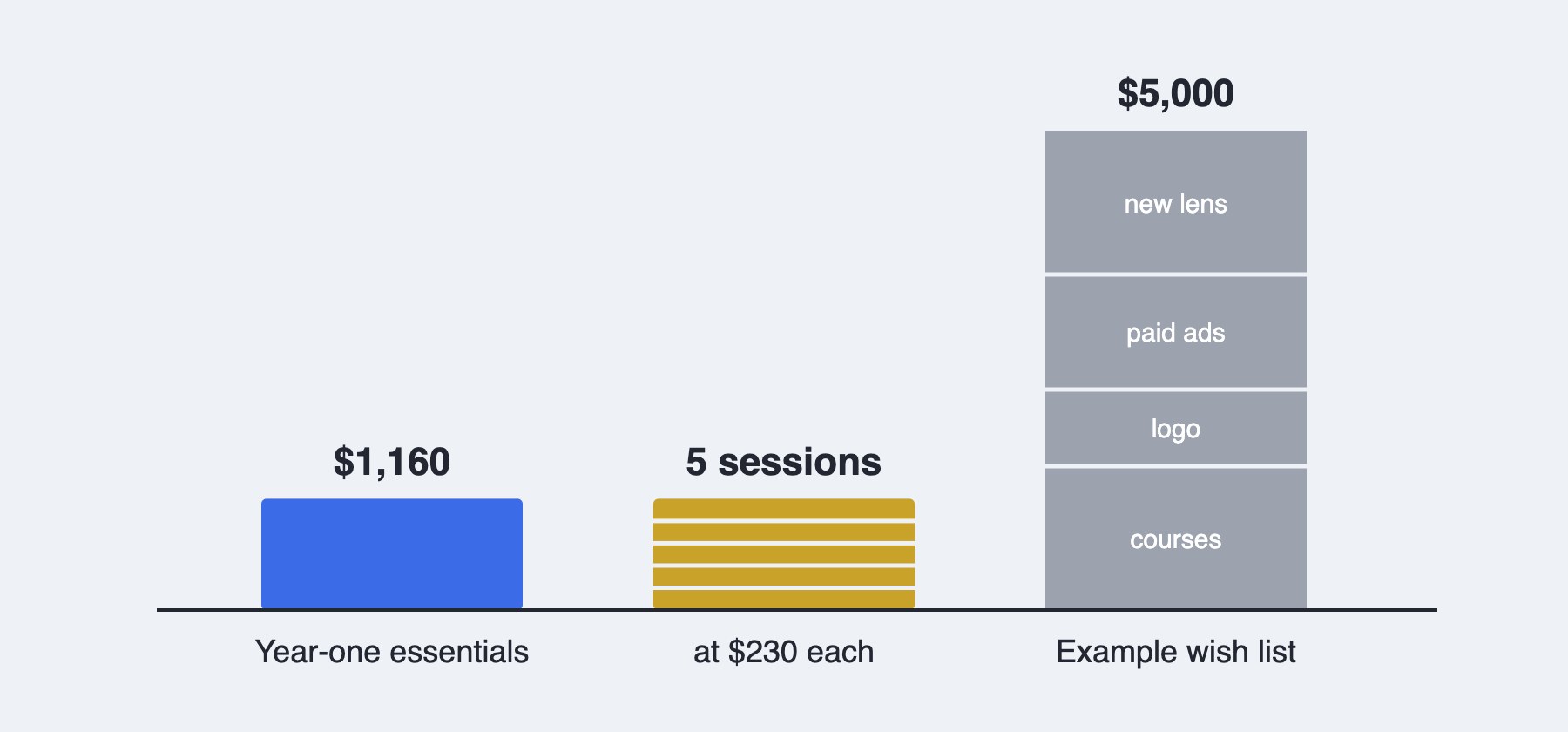
Compare that with a wish list that is easy to talk yourself into: a new lens ($1,500), a few months of ads ($1,200), a logo package ($800) and a couple of courses ($1,500). That is $5,000 (example prices), more than four times the essentials, and none of it is a reason for a client to book you.
What should you skip in your first year?
These are the purchases that feel like progress and are not:
- A lens or body upgrade before your tenth paid shoot. Clients book your photos, not your gear list. Shoot with what you have until a specific job needs something you cannot rent. Renting for a weekend costs a fraction of buying.
- Paid ads. Ads send strangers to your portfolio. Until the portfolio shows the exact kind of session you are selling, you are paying to show them the wrong thing. Your first clients come from people who already know you.
- A logo and brand package. Your name in a clean font is enough. Spend that money once you know who your clients are.
- A studio lease. A recurring cost before you have recurring income. Parks, clients' homes and day-rate studios cover almost every portrait need.
- Courses and preset bundles in bulk. One good course on the business side beats ten on editing styles. Free tutorials cover the rest.
- Software you will only use 10% of. Big studio suites are built for studios with assistants. A solo photographer needs booking, contracts, deposits and delivery to work, not a pipeline dashboard.
One exception: if you shoot weddings, a backup camera is not optional. A body that dies during the vows cannot be reshot. Borrow or rent one for your first weddings before you buy.
In what order should you set things up?
- Pick one kind of photography. Families, weddings, headshots, brands - pick one for the year. A portfolio of 20 family sessions books family sessions; a portfolio of everything books nothing in particular.
- Set your price from your own numbers. Start from what you need to earn and how many sessions you can realistically shoot and edit, not from what the photographer down the road charges. See how to price your photography.
- Get your contract and deposit in place before the first paid shoot. Decide how much deposit to take and when it becomes non-refundable; we did the cancellation math here.
- Set up backups before you need them. Two local copies plus one off-site, and do not format a card until the shoot exists in all three places. If your off-site copy is Google Drive, upload finished shoots into their own folder instead of syncing your working drive, so a file you delete by mistake on your computer is not deleted in Drive too.
- Put up a booking page and a delivery gallery. This is what makes a beginner look established: the client books a time, pays the deposit, and later gets a gallery that looks as good as the photos. Our guide on how to deliver photos to clients covers the delivery side.
- Get insurance before your first venue shoot. Some venues will ask for the certificate weeks ahead.
- Then tell people. Friends, family, past colleagues, a local Facebook group. Five sessions is a reachable number from people who already know you.
Do you need to register a business or an LLC?
You need to be able to take payments legally and pay tax on them, which in most places means registering as self-employed or as a sole trader at minimum. Whether an LLC or a limited company is worth it depends on your country, state and income, and the filing fees vary widely, so we left them out of the budget above. Ask an accountant once, early: it is cheaper than fixing a year of messy books.
Where Ultra fits (disclosure included)
We built Ultra to cover two lines of that list for solo photographers: the booking page and the delivery gallery, on your own domain. On the Pro plan ($14 a month, or $119 a year) clients pick a slot from your live availability, get confirmed automatically, and can pay through your own Stripe account. Ultra takes no commission; Stripe's fee still applies. Client galleries are flexible: pick a template, then change the cover, the grid layout, the photo shape and the spacing until they look like your work, with password protection, favorites and notes for clients. If your shoots already live in Google Drive, you can pull them into a gallery straight from Drive instead of uploading them again. The Starter plan ($9 a month) has the galleries without booking. There is a 14-day free trial, so you can set it up before your first paid client.
Ultra does not replace your contract, insurance, editing software or backups. Those stay on the list whatever you use.
The one exercise worth doing this week: write your own version of the table above with real quotes, then divide the total by what one session leaves you. That number is your first goal for the year.