

Charge a deposit that covers what a cancellation actually costs you at the moment it is most likely to happen, and cover the rest with a written cancellation schedule. For the $3,000 wedding in the worked example below, that means a reservation deposit around 20% ($600) plus a second payment that becomes non-refundable closer to the date. One flat percentage cannot do both jobs, because a cancellation nine months out and a cancellation two months out cost you very different amounts.
Key takeaways
- Size the deposit from your loss, not from what other photographers charge. The loss is the profit on the date you can no longer resell plus the hours you already spent.
- Payment processors keep their fee when you refund. Stripe states that its "processing fees from the original transaction aren't returned" (Stripe refunds docs).
- In the UK, the CMA says a genuine deposit can be kept in full, but "will not normally be more than a small percentage of the price" (CMA37, para 6.62).
- Late-cancellation losses belong in a cancellation schedule tied to real costs, not in a giant up-front deposit.
We build Ultra, a booking and gallery platform for photographers, so we have an interest in how you take payments. Every rate below links to the provider's own page, checked on September 30, 2026. This is business math, not legal advice: deposit rules differ by country and state, so have your contract checked locally.
What is a photography deposit actually for?
A deposit pays you for holding a date that you would otherwise sell to someone else. It is not a down payment on the photos. That distinction matters because it tells you how big the deposit should be: exactly as big as the damage a cancellation does to your calendar, and no bigger.
The damage has two parts. First, the date itself. Once you say yes to one couple, you turn down every other enquiry for that Saturday. If they cancel, you only get the money back if you rebook the date, and the closer the date, the less likely that is. Second, the work you already did, such as the consultation call and the day-of timeline. Those hours are gone either way.
How do you calculate the right deposit?
Work out the value of the date, then multiply by your chance of not rebooking it. Here is the math on a $3,000 wedding, with example numbers you should replace with your own.
Step 1, the value of the date. Not the full price. If the wedding is cancelled, some costs disappear with it: the second shooter you no longer pay, travel, the album. Say those come to $900. The date is worth $2,100 to you.
Step 2, your chance of rebooking. Look at your last two seasons. How often did you rebook a cancelled date, and how far out was the cancellation? For this example, assume 80% if the couple cancels nine months ahead and 20% if they cancel two months ahead.
Step 3, add sunk hours. Say 2 hours of work by nine months out and 4 hours by two months out, at $75 per hour.
| Cancellation | Unrebooked date value | Sunk hours | Your real loss |
|---|---|---|---|
| 9 months out | 20% × $2,100 = $420 | 2 × $75 = $150 | $570 |
| 2 months out | 80% × $2,100 = $1,680 | 4 × $75 = $300 | $1,980 |
A $600 deposit (20%) covers the early cancellation almost exactly. It covers less than a third of the late one. To cover $1,980 with a single up-front payment you would need a 66% deposit, which scares off good clients at booking time and, in some places, is the kind of term regulators call a disguised penalty.
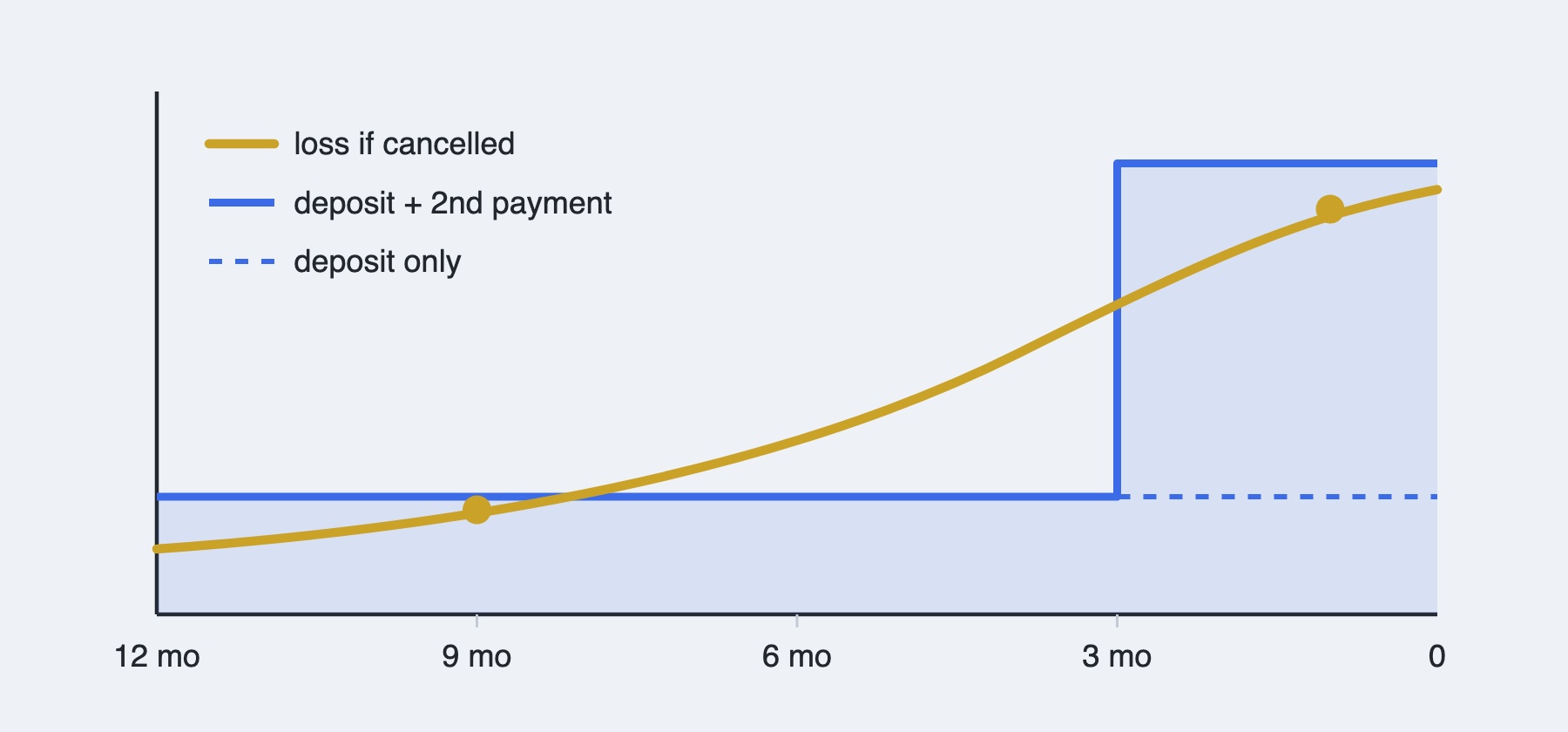
Why one flat percentage fails
A flat deposit is sized for one moment on a curve that keeps rising. The fix is to split the job in two:
- A reservation deposit at booking sized to the early-cancellation loss. In the example, $600.
- A second payment on a fixed date, for example 90 days before the wedding, with a contract clause saying that from that point a cancellation keeps an amount that reflects your actual loss. In the example, enough to reach about $2,000 in total.
This mirrors how the loss actually behaves, and it reads as fair to clients because each payment lines up with a commitment you are making to them.
Can a photographer keep the whole deposit?
Often yes, if the rules are clear and the amount is reasonable, but it depends on where you and your client are. The clearest regulator guidance we found is the UK's. The CMA's unfair contract terms guidance (CMA37, updated July 22, 2026) says in paragraph 6.62 that a genuine deposit may be kept in full if it works as a binding reservation and you explain up front "the precise circumstances in which it would be non-refundable". The same paragraph adds that such a deposit is normally a small percentage of the price, and that a larger prepayment "may amount to a disguised penalty". It also says you can more fairly retain sums that cover your "unavoidable net costs or the net loss of profit", which is exactly what the table above calculates.
Two consequences for your contract:
- Write down when the deposit is non-refundable. "Non-refundable" alone, with no circumstances, is the weakest version.
- If you cancel, the client gets their money back. CMA37 also says a consumer who loses the service through the trader's breach is normally entitled to a full refund. If you double-book or fall ill without a replacement, the deposit goes back.
In the US, deposit and cancellation rules come from state contract law, so the same logic (tie retained amounts to real losses, spell out the circumstances) is a good starting point but not a guarantee. Ask a local lawyer to read your cancellation clause once; it is cheaper than one disputed wedding.
What does taking a deposit online cost you?
The processor takes its cut whether or not the wedding happens. At Stripe's US rate of 2.9% + 30¢, a $600 deposit costs $17.70 to collect. If you later refund it, Stripe keeps that $17.70. If the client disputes the charge with their bank instead of asking you, Stripe charges a $15 dispute fee on top, and another $15 if you counter it (refunded if you win).
That gives you two practical rules. Do not refund and re-charge to "move" a deposit to a new date; transfer it in writing instead, or you pay the fee twice. And make your cancellation terms visible at checkout, because a client who knew the terms is far less likely to go to their bank than to you.
For mini sessions the math is simpler. A $250, 20-minute slot is small enough that full payment at booking is normal, and at Stripe's rate it costs $7.55 to collect. Offer a reschedule into another slot rather than a refund, and you keep both the booking and the fee.
Where Ultra fits (disclosure included)
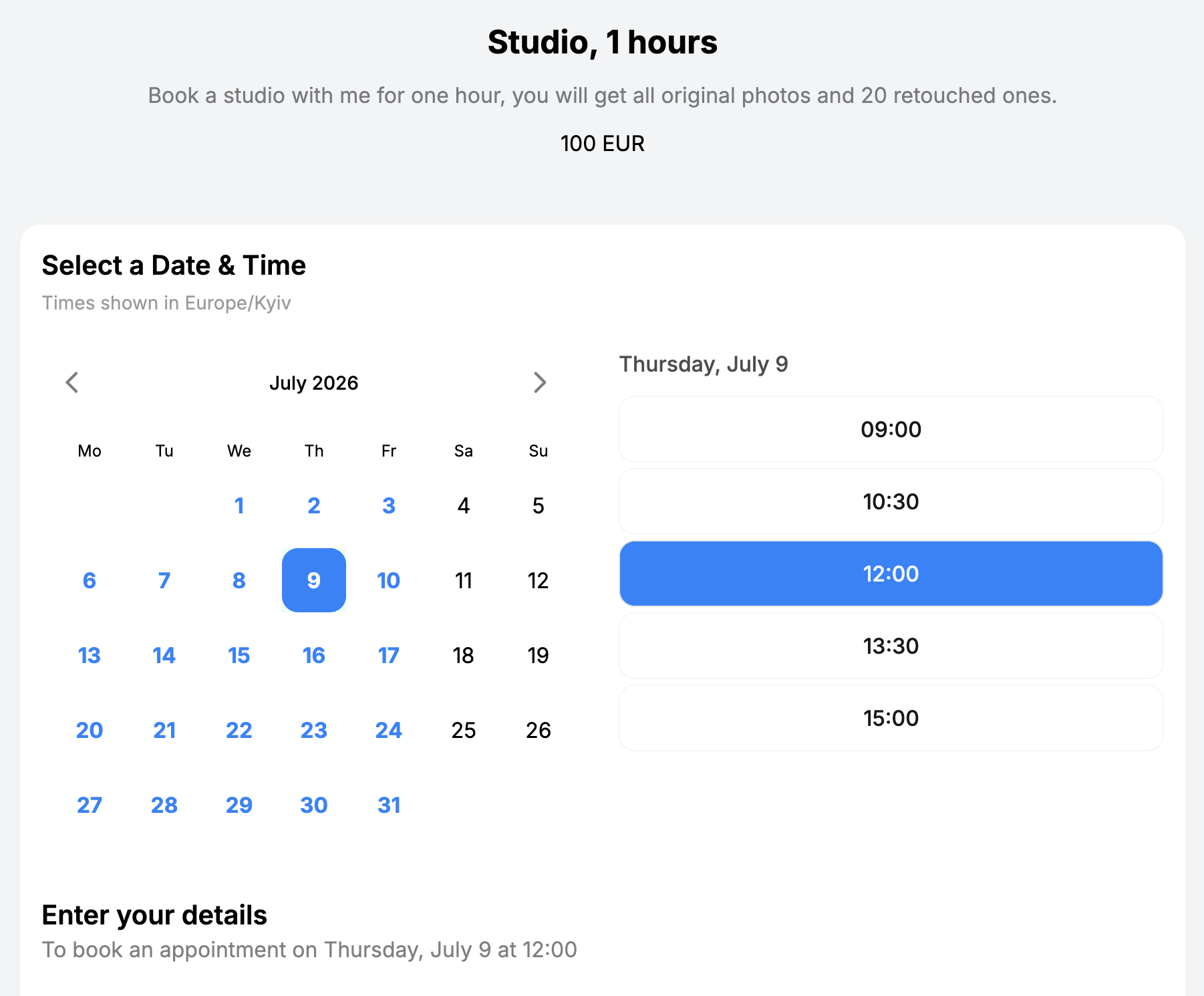
Ultra's online booking lets clients pick a live slot on your own site and get confirmed automatically, with each session type carrying its own price. Collecting the deposit or full payment at the moment of booking is on the way but not live yet: it is marked "coming soon" on the booking page. Until it ships, Ultra holds the slot and you collect the deposit through your processor or invoice. When it does ship on the Pro plan, Ultra will add no commission of its own; the processor rate above still applies, as it does everywhere. For the full fee comparison, see the real math of photography payment fees.
The one exercise worth doing this week: open your booking records for the last two seasons, count cancellations by how far out they happened, and fill in the table above with your own numbers. Your right deposit is the number in the first row.